Sunday, June 5, 2011

Starting to Garden?

Thinking about starting a garden of your own?   Last year I tried to write up some of the information I'd gathered, read and discovered by gardening on my own and put it in a website for beginning gardeners.  It's got free resources for Boston-area gardeners, plant-by-plant growing tips and how-to's on starting your own plot.  Check it out.

https://sites.google.com/site/abbymachsoncarter/home/boston-backyard-gardener

Wednesday, June 1, 2011

Memorial Day, Redux, 2011


 It's funny, I thought this year was much colder and wetter than other years... (we just had our first stretch of warm, sunny weather in the last few days of May)...but looking back one year in the blog, I noticed a post with the same title as this one....apparently, last year memorial day was also the first time it got warm enough to put everything in the ground (especially tender stuff, like the tomatoes and eggplants.)   And I thought I was slacking.  Nope, turns out we just live pretty far north, in the scheme of things.   Reading Barbara Kingsolver's Animal, Vegetable, Miracle (my annual re-reading), she talks about putting in tomatoes and harvesting lettuce in the first week of May.  I feel only pissy envy ("Well, if we all lived in Virginia, maybe we could all have an extra two months growing season, and maybe I could grow melons and okra and peppers that needed their own cages!).  
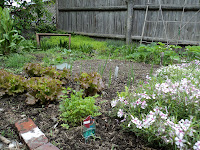
"upstairs" back garden: shade-tolerant

As it is, weather is a huge part of our limitations as gardeners up here, and getting to know, and possibly accept, the growing cycle, is a part of it.   I know I shouldn't be shocked by looking back to last year's May pictures, but when I remember last year's garden, I remember the July version - five foot tall tomato plants and every possible growing space filled with plants, or, less happily, weeds.   Its a big surprise to see how much last year's Memorial Day pictures look like this year's.  I guess I feel like I should be starting earlier, or the weather should be warmer - I should be ready to eat things by now.   But its just not time yet. 
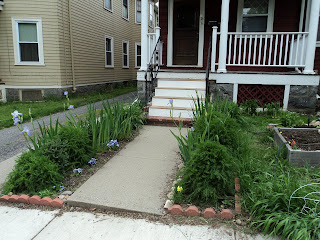
My second attempt at a perennial border, May '11
Here's what I try to remind myself: June is when we harvest lettuce, peas, bok choi, broccoli (if we're lucky) and maybe some tiny carrots.   Beans, cukes and zukes won't be until July, tomatoes and eggplants at the very end.   And then the season goes until mid-september. Be patient, I try to tell myself, but it feels unfair.  It's exciting to be eating fresh-grown stuff right from the backyard - nothing tastes quite like it - but if we want to try to eat garden-fresh all year long, its a lot to bank on basically eight weeks.   This year I opened up a new bed and planted it full of Roma tomatoes for canning - two hybrid romas, two heirloom "paste" tomatoes.   It feels like a luxury to devote a whole bed just for canning (and don't worry, I'm trying to squeeze out every inch of space from it before the tomates get big), but I think its something I want - its been fun to make sauce from our home "cans" this winter, and it would be easier with more Romas, even if they are more "meaty", less spicy-juicy than some of their heirloom cousins.

This year I am trying to be mindful about where my gardening energy goes - I'm trying to think about what I really want to eat, not just how I can cram in the maximum number of plants.   And so far, it feels good.  I know that we can never get enough carrots, peppers, cucumbers or tomatoes, and I love my pickled, canned beans, so I tried to make space (or give space) to a lot of those.
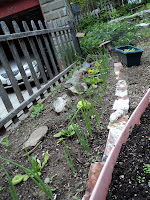
Onions, lettuce, and tiny peas along the fence. 
I loved my tiny golden beets from last year, and now there is a beet patch.   But gone are chard and zucchinis, big broccolis and a huge sunny spot devoted to herbs.   The broccoli takes up a lot of space and barely gets going.  The Zucchinis always get borers.   The herbs have been moved to shadier locations, freeing up space.  And nobody ever ate the chard.   The carrots were planted all at once, instead of the whole-summer labor of love that used to be devoted to getting a new crop every two weeks, like the package recommends, and always ends up confusing me about what to harvest when.   We're working here for maximum satisfaction, maximum yumminess, for the least amount of stress and worry.  I've been putting lots of time into the garden recently, but that's because I have the time, and the weather is beautiful.  Later, I hope to not feel guilty about not doing enough or not eating enough of the produce.   If I don't get a second crop of lettuce or peas, I'll try not to fret.  Sure, I'll work my butt off canning tomatoes and making bean pickles (and possibly sauerkraut, this year) - maybe I'll coerce Dawn into drying some herbs.   But I'm planning on harvesting the lettuce young (no more waiting for it to reach "full size" and have it bolt) and the carrots all at once.  I'm not trying to plant in marginal spaces anymore - I'm letting those go back to weeds and groundcover (and a violently virile oregano plant), and not wasting time planting anything where it won't thrive.   I planted only potatoes and onions in my community garden plot - the kinds of things that can make it through a few hot days without any water, much less TLC.  I'll give away what I can't plant or eat.  Or at least, that's my plan.   In May, this is my intention: to enjoy what I can, and not sweat the small stuff if I can't.  (Let you know how it goes.)

Peas...soon w/ peppers and tomates
Garden diary:  By now, the carrot seedlings have shown their heads as have the beets.  Both are a little patchy.  The spinach is hardly growing, as usual, but the lettuce is big enough for a baby harvest, radishes on their way.   This year I planted a bunch of cabbages (where the herbs used to be), and they are looking good.  Tomatoes, peppers, and eggplant in the ground, bean teepee still needs to go up. (pics from May)   Tasted first strawberry today- tart but very good.  


Here's some pictures from the May garden, before the sun came out.  


I'll have more of  the June garden soon...
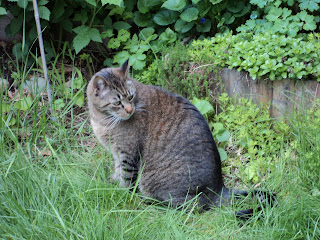
Monkey

Dawn's front Raised Bed...in May.   Compare with May 2010....


Peas in the back. Party in the front. (radishes in the middle).  Cucumbers coming later.

Schlubby potato buckets (by now they've just sprouted)

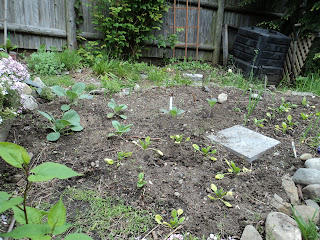
Spinaches planted, w space for eggplant (I call this my "no dirt left behind" policy).


Tuesday, May 17, 2011

Rain, rain, go away....

Well, spring has come around again, the semester's ended, time to blog again.  Well, usually I make my peace with New England's cold, wet springtimes.   Back in March, when "spring" "starts"  I remind myself that the last expected frost in Boston is at least mid-May.   And all April, when its freezing at night, I don't get bummed out. There are plenty of plants the prefer the cold weather and need an early start - especially since the window between "icy snow" and "boiling summer" is so short around here.   This spring it's been awesome to get out on the nice days and actually put something in the ground: little baby kales, cabbage, broccoli, spinach and lettuce transplants, pea seeds, onion bulbs, and carrot, radish and beet seeds.   Unfortunately, even though all these plants do ok in the cold, and could probably even stand a frost - damn, its been cold.   And cloudy.   So nothing's died, yeah, but nothing's really grown, either.   The peas came up and are a couple inches tall, and a few beet and carrot seedlings are starting to poke their heads up, but its off to a slow start.   Feeling hopeful, we got a couple of tomato, basil and pepper seedlings at Home Cheapo a couple of weeks ago (plus my one requisite eggplant) - but so far, we are keeping them inside, on a sunny windowsill, waiting for it to get a little bit warmer.    Sigh.  I'm ready for summer.

I've also done a little re-organization since last year, trying to maximize sunlight....we'll see how it goes.  Pictures to follow!

Friday, January 21, 2011

Food writing, Memoir, and fearful fiction....

Well, I like to write things on my own in my blog, but when I find someone else's writing I like, I'm inclined to share.    I'm in a master's program for fiction, but recently I find myself drawn very strongly to certain types of non-fiction - especially the kind that uses food as the hook, line and sinker to draw us into personal stories.   I found one today, by food writer, restaurant owner and, I think, MFA fiction graduate Gabrielle Hamilton.   (link at the bottom of this entry).  

Monday, January 10, 2011

We Made Cheese!!!!

This is where the magic happens!
Listen, I"m still impressed that I can grow my own lettuce.  So this next step is blowing my freaking mind.   We made.  Our own.  CHEEEEEEESE!  

And the next step to world domination is complete.   wha ha ha! 
I'm not going to describe the process in detail, since there were about eight steps.    But sufficeth to say, we bought a cheese-making kit from the Homebrew Emporium in Cambridge, MA and followed the directions.   Of all our food-craft projects we've attempted so far, I might venture to say that this was actually the easiest:  30 minutes from start to finish, minimal clean up, yummy product, and other than the kit, all the ingredients (milk, not ultra-pasturized) were available at the Stop and Shop.   Sweet.

That's me stirring the curds, and the whey, w/new apron. 

The process involves mixing rennet and citric acid into a gallon of milk, heating it, letting it sit a little....um, some more stuff (we kept the kit and instructions, don't worry!).   I will say, we separated the curds and whey, and all I could think was "Little Miss Muffet, Sat down on a Tuffet...." the whole time.   


Eventually, the curds separate, we drained the whey and stuck the whole mess in the microwave for about 45 seconds. 


    "No Whey!"    "Whey."
Then....basically, it got kind of messy and we forgot to take pictures. (There are some hilarious movies that may make it onto YouTube).  But we stuck the curds in the microwave, then, with a brand-new (almost) pair of dishwashing gloves, we followed the instructions to: stretch and pull like taffy.   ("OK," I said, "here goes nothing"  and proceeded to pull with abandon).   Then, it started looking like cheese!   I rolled it into little balls and tossed it in icewater.   Here are the results:
It's pretty delicious, and Dawn went right ahead and made herself a little tiny home-made pizza.  


I waited until tonight, and got to make "homegrown" lasagna...sort of.   Well, it has home-grown tomatoes in the sauce, plus frozen pesto and homemade mozzarella.   Pretty darn cool. 

Yum.

Friday, December 31, 2010

New Year's Eve

Pickled beets, dilly beans and canned tomatoes, all dressed up for Christmas
How do I end up posting right before the holidays?   I guess on an academic calendar that's when we have time.

Well, as the sun sets at 4:20 pm on New Year's Eve, 2010, I'm doing my little reflecting thing.  The day has been intensely, beautifully quiet, the way only winter in New England can be, especially when you have no "outside" responsibilities: family, school, work.   We're done with all the parties, entertaining and gift-giving, lesson planning and paper writing, deadlines and test-taking.   At least for a little while.   And so I, happily, turn to food.  And not just eating it, which has started to feel like a recurring bad habit with all the holiday meals we've been served (thank you, thank you, we are grateful for the hard work and abundance that went into them - oof, my pants feel tight!  :).

No, I'm talking about the work with raw ingredients that has, over the past few years, started to feel so intensely personal, soothing and healing for me.  I spent today boiling and bottling orange-flavored homemdade vinegar, my head blissfully woozy from the scent of all that boiling vinegar.

Wednesday, November 24, 2010

Keeping the Harvest.....

So it's been far too long since my last blog post, but now, the day before Thanksgiving, I finally have a little time on my hands.

The garden has been put to bed, almost.   Late to mid October, me and Dawn cut down the tomatoes, peppers, eggplants, beans, cucumbers and broccoli.   I pulled up the last of the carrots (some of which, left to grow the proper amount of time, actually got to a decent size!) and beets (ditto), pulled off the green peppers, hoping they'd go to red in our fridge, and gathered up all the green tomatoes to bring inside.

It's comforting, after a few years, to start to have a ritual.   Now I know when the heat goes on in late October (we can never make it to November 1!), upstairs comes the little wooden, three-shelved "onion box" I got at an unfinished wood store, with little mesh grates on the doors.   It lives in our back hallway all winter, our impromptu "root cellar" where we keep onions, potatoes garlic and winter squash.

The dried garlic and onions I grew are gone - I always mean to keep them longer, but they are so good, I always say, what the hell, what if they spoil, live for today, and they go into everything I cook between August and October and then they are gone.  :(  Every year I vow to plant more.

The last of the potatoes are hanging on, and I am carefully plotting their fate, planning my last few potato dishes with them in mind.  But we are moving into a different phase of year, here in New England, something I am slowly getting used to.   When I realized that tomatoes, eggplants and peppers were only fresh here for a few months (more like six to ten weeks!), it brought me down.  How the heck are you supposed to eat the lush, sweet, local produce everyone rhapsodizes about, when October-May practically nothing grows?

Well, some people use season-extenders, which I'd like to learn more about, just like everything else I'd like to get around to (sewing buttons back on my coats, selling my stand-alone Ikea closet from two houses ago on Craigslist, writing a novel).   Apparently, with the right cold frame, you can get lettuce in January (and I might believe it - my lettuce is still going strong!) but until then I'll have to stick to a tried-and-true old farmwife tradition: food preservation.

So, a few seasons into my New England gardening education, it suddenly dawned on me: old school (ie, colonial) housewives couldn't go to the supermarket in January to get food.  They knew this in the flush seasons of July and August, and that is where our very most basic "processed foods" come from: jams, jellies, pickles, ketchup, mustard, relishes and sauerkraut, wine and beer.   Who knows if the nutritious value was preserved (was it?) but at least they had a little variety.    It also explains the difference between what we know as "Italian cuisine"  and "German cuisine."    Italy is linked with tomatoes, basil, zuccinis, and other fresh veggies of every kind.   Well, guess what?  It stays warm in Italy for a lot longer than in Germany, which is famous for bratwurst, beer, and sauerkraut.  Or worse, Russian food, where tomatoes often barely make it to ripe at all.   This is actually where my ancestors come from, and it is known for hardy root vegetables: potatoes, cabbages and beets.   Black bread.    Why?   Not because they are unhealthful and hate salads, but because this was what was available.