Tuesday, October 19, 2010

A blog which has nothing to do with gardening

So, after sitting around in a classroom discussing the future of the "publishing" industry, I listened to an awesome new-ish album (2009) and read about how one local performer is DIY-ing her way to financial solvency: Amanda Palmer.

The concept is - the old model of paying artists was to have them "signed" (or for writers, "contracted") to a major label (or publishing house) which would then front the costs of producing and distributing your media.   Now that often that we as writers can create and distribute our media ourselves....do we need that big contract, that big signing?   Well, it certainly would be nice to get an advance..... but is there another way?

I liked this short description of how Amanda Palmer made money simply by promoting herself.  Of course, its a bummer that such a cool, off-beat punk-indie-rock-cabaret (caberet??) artist would not make money off her album.   But its fantastic that she is doing her own promotion, and getting contact with her own fan base directly.   As such a quirky (and dark) non-pop artist, there's always going to be a limited audience - so how do those of us interested in quality over popularity, innovation over selling out, um, sell ourselves?
read on for one possibility....
(I of course would prefer that I didn't have to auction off my stuff, but whatevs...)

http://www.suite101.com/content/amanda-palmer-saviour-of-the-music-industry-a130519

ps: the album is great.  Paste to browser to listen to a song....

http://ilike.myspacecdn.com/play#Amanda+Palmer:Guitar+Hero:44419473:s28038082.9144795.3088909.0.2.221%2Cstd_36382125cd664a549cad6ca3fb25527d

Monday, October 18, 2010

Annie Proulx, gardening and fiction

E. Annie Proulx: (2000) "All over this scratched and worn earth regional and rural cultures, the natural world, and the diversity of life itself are eroding and crumbling under terrific outside pressures. For more than a decade, through the medium of fiction, I have been trying to catch pieces of North American rural lives and ways squeezed in the pincers of change. For me everything begins with the great landscape—not scenery but soil and water, climate and weather, indigenous plant and animal life, geography and geology. Against this background human adaptation to, and exploitation of, that landscape in a particular time orders the personalities and characaters of my stories, shapes the stories themselves which must tumble out of the place portrayed. I am concerned as well with the growing gap between rural and urban attitudes and behavior, the rural perception of the economic forces that call out the marching orders."


This summer I started two blogs: one about my garden, and one about my writing and teaching.   I haven't wanted to write too much about the teaching, namely because I tell all my students (I can't believe I have students!) to look at my blog, and then where am I? 

But it's felt like a funny stretch for me, writing about my backyard and my devotion to my tomatoes, beans and peppers, and then also trying to keep up my fiction.  I've always placed these in two separate boxes - writing is indoors, public, and professional, while gardening is outdoors, a private and amateurish pleasure.   But I've known in my heart that they were linked, a kind of ying and yang.   Writing involves sending my mind fixedly far away from the here and now.   Gardening pushes exactly the opposite buttons - it is a radical rooting in the here and now - the smell of this tomato bush, the stink of the compost, the wet or dry dirt, the hidden bean harvest, the way my fingers learn to find little weeds and pull them out.  It's an immersion in sights, sounds and smells - tiny little lacewing insects, flies, worms, birds, caterpillars, rot or growth on a plant.   The information is here and now.  And the product is for my pleasure only: no matter how hard I work to preserve the harvest, it will go.   Eventually, no matter how delicious a meal is, it will disappear into the belly of one of my friends, to be absorbed into their bodies or gone forever. 

Writing is the opposite - it is sitting alone in a little room, the quieter the better, and the only senses triggered signal distractions: a tea kettle, cold feet, the phone ringing, someone at the door.   The world here has to come entirely from our mind.   And it's not to be enjoyed now - what we make now might disappear forever.  But the final product is a kind of everlasting pie - I can (hopefully) pass it around to a world's worth of "relatives" - and unlike a pie, enjoy it or not, it will last months, maybe years. 

Tuesday, October 12, 2010

Review of "Radical Homemaking"

So, in the inevitable crossover of my literary and gardening pursuits, I present for you a witty and charming review of a book I fully intend to read (just as soon as those dang beans are harvested, the tomatoes safely in their winter storage box, and  my entire herb garden moved!).

http://www.thesmartset.com/article/article08311001.aspx

Enjoy.


On an update note, this blog seems to have gone as my gardening goes.....super heavy and intense at the beginning of the season, then trailing off a little as August makes everything go crazy, and down to barest maintenance as school starts up and life gets busy in September.    The basic update:  the cool weather slowed down all my fall crops, but I'm still harvesting a little lettuce, beans galore, tomatoes and peppers.  I have ripe bok choi, but can't find the time to eat it.   I've made chili, tomato sauce, steamed beans, more tomato sauce, all sorts of middle-eastern style Tagine potato, eggplant and tomato and pepper dishes, etc. etc. in various combinations.    In general, I have it down to a science at this point:   beans are cleaned, tipped and tailed, and frozen in plastic bags.   Tomatoes are sliced in half, cored and de-seeded, sprinkled with olive oil, a little salt and maybe rosemary, and roasted on parchment paper in a 200 degree oven for 1-5 hours.   (1 hour for making sauce later that evening, when, cooled, the skins slip off pretty easy, 5 hours for bagging and freezing).   cucumbers and peppers are eaten ASAP.   It's nice now, that planting is all done and harvesting, cooking, preserving and eating are the biggest chores.   Looking out now for the first frost, so we can grab all the tender plants before jack frost does!

Tuesday, August 31, 2010

How to actually process tomatoes!

I'm re-posting the link to my friend Janelle's blog, where she actually tells you in some detail how to do the things I airily whisked onto my blog, not giving y'all the hint that I spent hours trying to figure out how exactly to (safely) dry, roast, freeze, puree and can tomato products.   It's definitely a learned art, and Janelle gives good directions.  (also bomb-ass pictures).

http://creativehomesteading.blogspot.com/2010/08/tomatoes.html

My only note of caution about preserving is to always follow a recipe and to never, ever try to preserve something in oil.   I had one book tell me to let my dried tomatoes sit in olive oil, to make "a delightful sauce for soups and salads".   I thought, ok, added garlic and it quickly turned moldy, thank goodness, because that turns out to be a fairly perfect botulism environment.   Vinegar kills just about everything it touches, and is safe (thus we have pickles, catchup, mustard and mayonaise), but if you want to make a flavored olive oil, I'd use it within a few days and store it in the fridge.   For the dried tomatoes, they might be acidic enough to be all right, possibly add some vinegar to the mix and nothing else,  but I'm still leery.   

More on canning soon - hopefully with pictures!

Preserving and Perservering

Beans


Well, it's August, and you know what that means: full on harvest time.  Yes, there are still many chores to be done, but I feel like in August the bulk of the work shifts to inside the house - what to do with the tons of produce we get.   This year we got a CHEST FREEZER, and so instead of having to stand over a hot canning bath if I want to keep something, I can just pop a lot of stuff in the Freezer.  Like those beans.  Cool.

And, in this garden, you win some, you lose some.  I think I got 1.5 beets, after all that fussing over them.  I (fingers crossed) will have 1 really nice canteloupe.   And the squash bit it, hardcore.   In general, my plants seem to be able to fight off most bugs that attack their leaves.   But we got squash vine borers, that get the part of the plant that goes into the ground, and pretty much finishes them off.   So no squash.

But we are pulling in 5-15 tomatoes a week, including some heirlooms, 3-4 cucumbers, and maybe 20-30 new beans every time I look outside.   The onions, potatoes and garlic are in, so I can cook with those, and the eggplants are producing on schedule.   Peppers - well, lots of green, we are holding out for red.   And I'm trying to coddle some late-summer lettuce, bok-choi and peas - so, in general, I'm feeling pretty well fed.

The food goes into stir-fries, pesto, tomato sauce and salad.   I also got ambitious with the tomatoes and beans:   The umpteen beans got turned into a sort of bean-based pesto type dip, that is really delicious, and frozen for future parties.  (Babs Kingsolver calls it "frijole mole" - most people seem to think it's: strange but good)
http://www.animalvegetablemiracle.com/Frijole-Mole.pdf

Into the freezer can now go pesto, bean dip, tomato puree, roasted tomatoes, and whole beans.   I'll get to canning and pickling in a week or two, when it's a little colder.

And with the tomatoes, I"m trying it all.   I've peeled, cored and seeded plenty of my over-healthy romas to make from-scratch sauce, run them through my roma-3000 (or whatever it's called) to freeze the puree, and even bought extras to put away. - well, I bought about $10 of almost-ripe heirlooms at the farmers market to try preserving.   As per my book (The Busy Person's Guide to Preserving Food, by Janet Chadwick), I sliced the tomatoes up thin and left them in Dawn's food dehydrator until they became, and I quote, "leathery" and put them on my shelf, and also roasted a bunch at 225 degrees, with olive oil, to freeze (note to self: 6 hours waaaaay too long for thin sliced tomatoes to roast - anyone want burnt-up tomato chips?).

So, to all my friends who have cooked with me, and to Dawn who has suffered the effects of my vegetable mania ("OK, so I'll cook the carrots and the beets together, the beans on their own, we'll mash the potatoes, oh yeah and the corn, and what about a salad....?"), thanks for the help.    I'm excited for the cooler weather and some canning, because who doesn't feel good with jars and jars of home-grown food on their shelf?


Sunday, July 25, 2010

Sunday in the garden + potato salad recipe

I spent this Sunday afternoon  as I've done for the past couple of weeks: in the garden.   There's lots of other stuff I should be doing on Sundays - writing, grocery shopping, paying bills or getting my car fixed.  Looking for work in the fall.   But there's something truly seductive for me about the backyard on a quiet weekend afternoon.   It's at the point right now where the garden needs a few hours of work a week, and then it will be more or less happy.   But its just a wonderful thing to do, on a day to myself, to give attention back to the plants that will feed me.  Last week I fertilized the nightshades, peppers, and vines, and planted about nine more feet of carrots to come up this fall.   Even out in the hot sun, I love puttering out there: stringing up cucumbers that are trying to grow upside-down, pulling crabgrass out of the beds, checking the tomatoes to find out that we have FIVE new super-ripe Roma tomatoes.    Deciding to cook them up into sauce, and invite a friend over for potato salad.  Pulling up a few big, bulbed out onions, tiny beets, yanking out a few purple carrots that after 2 1/2 months are finally big enough to eat.   Emptying out a couple potato buckets to find out how they did, pinching suckers off the tomato vines, harvesting basil or sorrell, or transplanting teensy, tiny little lettuce plants from the shady part of the yard.   After a week full of work and driving around, errands and deadlines, it's nice to slow down for a few hours, exist in greenspace, and tend to something - All this week, I'll know that my garden will grow healthier, and more food will be ready because of the work I put into it.  

Upstairs, I cooked the onions under low heat, skinned and seeded the tomatoes, and stewed them together for a little bit of sauce, along with salt, pepper and some basil.  Ate it for lunch over raviolis - without any extra sugar, the tomato sauce was a little acidic, but full of flavor.   Potato salad tonight was a little bit more complicated, but the basic idea is fresh, boiled potatoes, oil, vinegar, a little bit of mayo, and anything fresh from your garden you want to add....


Tuesday, July 13, 2010

Hot Summer Harvest time


So after much too much time away, and several technical difficulties (many of these pictures were taken with the tiny camera on my Blackberry, thank you very much), I am back, and better than ever.
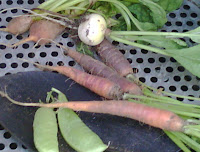
Last week, with temps in the 90s, rendered me completely incapable of caring about anything that wasn't air conditioned.  I guess that's why I'm a gardener and not a farmer, huh.   But a short visit with my friends at First Root Farm, for a writing-and-gardening workshop (what could be better?!) re-energized me, and I've been working my butt off in the garden, trying to catch up.  I got rid of the spring veggies - harvested the bok choi, cut down the last of the somewhat dead peas, and general clean-up.   Into every generation, they say, a Weeder is born, chosen to fight the crabgrass, the clover, and the lamb's-quarters that threaten the garden.   And right about now, I think that might be me.

A note on the farm - it's two friends of mine who founded an acre farm and CSA on a national historic park in Concord, MA - really inspiring and lovely - they welcome community helpers, and sell some kick-ass organic eggs, so check them out if you are into local farms.  http://firstrootfarm.wordpress.com/.


Other tasks: stringing up the tomatoes and cucumbers, more weeding, transplanting some underperforming cukes, and some squash that really randomly got into my columnar apple trees, more weeding, and HARVESTING!  The garden is just big and fertile right now, and a lot of herbs have gone to seed (note the gigantic dill), and they are all buzzing with parasitic wasps and flies, and other beneficial insects that help protect the cucumbers and beans.  The bean teepee has just started, and I'm pulling up a few (purple!) carrots, teensy beets, the garlic, an eggplant, a first zucchini, and the first round of potatoes!

I'm "curing" the onions in the basement, which basically means I set them on some old upturned pots and let a fan blow on them for a few weeks.  After that, they should be ready to store for as long as it takes us to eat them.   They say to harvest garlic when 1/3 to 40% of the leaves have turned brown.  Then wait for a dry day and gently dig them up with a shovel...or wait until they look entirely dead, like I did, and pull them up by their roots, which I also did.

Garlic!

For the potatoes, it's always a bit of an oddessy - most of mine are ready after 60-80 days, but I plant them so early, and then it takes weeks for them to sprout, so I never know when to start counting. Once they flower, you should be able to harvest baby potatoes after about two weeks.   My roommate, from Northern Maine potato country, said to start harvesting them when the stalks start looking a little dead and flopping over, and mine were starting to do that, so I dug them up.


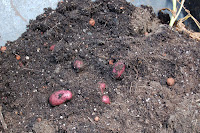
In the beginning, potatoes in pots.   Then, two months later, the pots got filled with dirt, the vines grew, flowered, and pretty much died.   But never fear, it's time for harvest!           
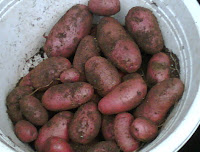


I love the way red potatoes look in the dirt.  It's like finding Easter eggs when you start to dig.  I stuck a shovel into the dirt under the plants, then started using a digging fork. I dug them up very carefully, but still speared a few with my fork - ate those last night!    The rest can get stored in my dark-but-air-circulating onion cabinet in the basement all summer and into the winter..if they make it that long.   We plan to eat these right quick.   These are a  "red thumb" variety of fingerling potato - they are not just red outside, but threaded with pink color inside - really beautiful and delicious.  These are the soft and creamy potatoes I was talking about.   The whiskey barrel did better than any other kind of growing - I was just rooting around the bottom for about fifteen minutes, pulling up more and more potatoes.   Good to know for next year. 

More pictures soon, but I'll leave you with one of my least favorite garden pests....they haven't been too bad this year, but in a rainy year they can get out of control - until I pour Sluggo on them (it's organic, don't worry) and then they just go away, poof!   Maybe some day I will have ducks to eat them in a very circle-of-life like manner, but for now, I loves me some Sluggo.


This sucker is seriously three inches long.


Escape!   Escape!  
(he didn't, don't worry)
(splat, bye bye sluggie!)